Six skill scores and written feedback after every session. Seven free practice sessions every 30 days, plus two free mock exams. No credit card.
Cambridge IGCSE French (0520) · Untiered · Works in your browser, on iOS and on Android
Free • No credit card needed • Works on any device
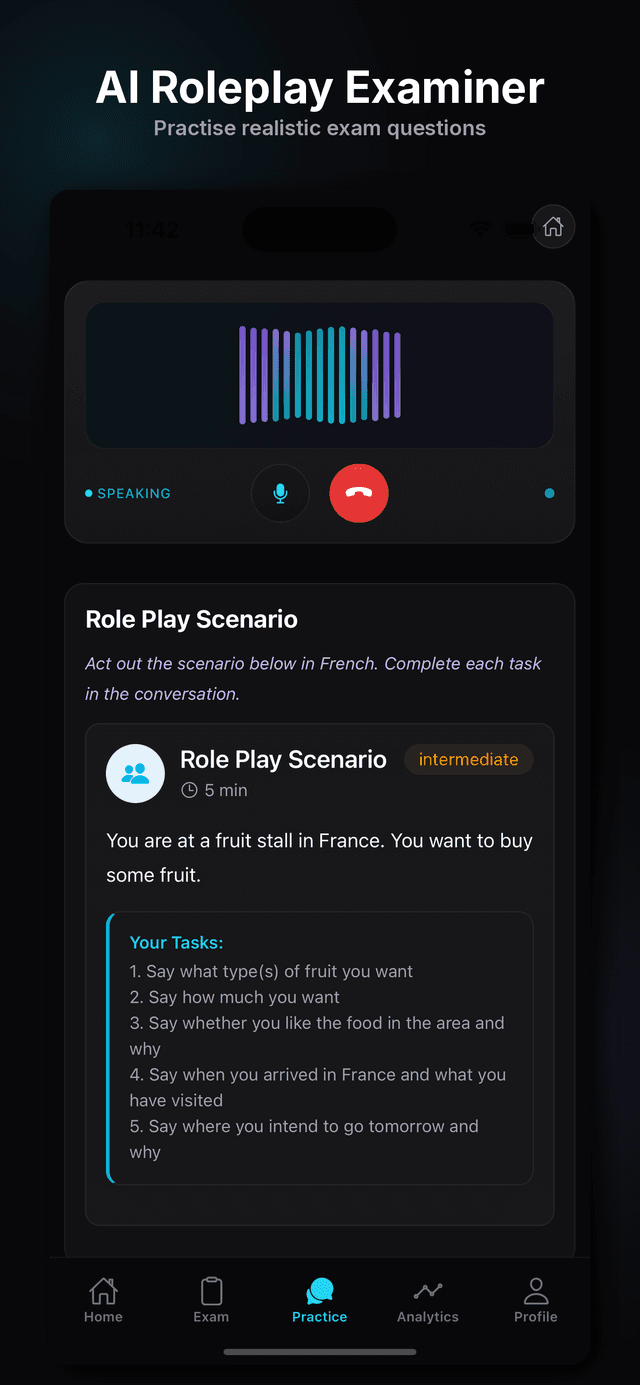
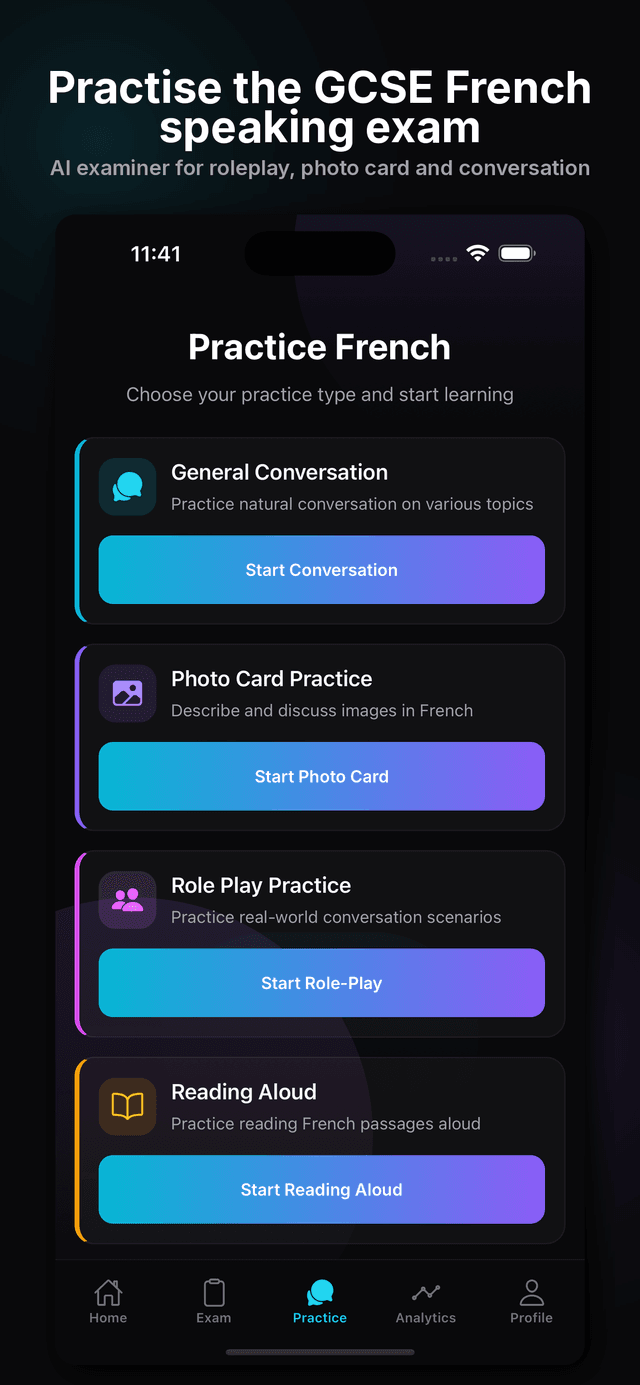
Practise every component with a realistic AI examiner that scores you the way the real thing does.
Five transactional tasks in a real-life French scenario — about two minutes, 10 marks. The AI examiner stays in role and responds to what you actually say.
About 4 minutes of unprepared conversation in French. Marked together with conversation 2 — 30 marks across both.
A second 4-minute conversation on a different theme. Fifteen marks for communication and fifteen for quality of language, judged across both conversations.
The whole test runs about ten minutes, and every candidate sits the same one — Cambridge IGCSE speaking is untiered, so there is no Foundation or Higher paper to choose between. It is graded A*–G.
| Stage | Length | Marks |
|---|---|---|
| Supervised preparation | 10 minutes | — |
| Warm-up | about 30 seconds | not assessed |
| Role play | about 2 minutes, five transactional questions | 10 |
| Topic conversation 1 | about 4 minutes | marked together with |
| Topic conversation 2 | about 4 minutes | conversation 1, out of 30 |
| Total | 40 |
Two things surprise candidates who have looked at UK GCSE material first. There is no photo card and no reading-aloud task — 0520 does not use them. And the two topic conversations are not scored one by one: they are marked together, fifteen marks for communication and fifteen for quality of language, across both.
You get ten minutes of supervised preparation before the test, during which you are given the role play scenario on a candidate card. You may not make notes. Dictionaries are not allowed at any point.
This is worth dwelling on if you have been revising from AQA or Edexcel resources, because those boards work the opposite way: fifteen minutes of preparation with notes permitted, handed in before you finish. Advice written for a UK GCSE — “plan your answers, jot down key phrases” — is advice you cannot follow in a 0520 exam room.
What you can do in those ten minutes is think. Read the scenario, work out who you are talking to and what you need from them, and rehearse the shapes in your head rather than the words on paper.
You are also not told the topics of the two conversations in advance. That is by design: the conversations test whether you can hold an unprepared discussion, not whether you memorised one.
The app runs the sequence exactly as the exam does.
No photo card. No reading aloud. No tier to pick.
There are 44 French IGCSE role-play scenarios in the app, set in everyday transactional situations — shopping, travel, work, accommodation and more — so you can practise repeatedly without repeating yourself. Every scenario is written in-house and follows the board's published format, timings and mark weightings.
Ten of the forty marks are on the role play, where the job is transactional: complete the five tasks. Simple language that does the job scores; elaborate language that misses the task does not.
The remaining thirty are on the two conversations, split between communication — whether you develop your answers, give opinions, offer reasons — and quality of language, meaning range and accuracy of vocabulary and structures. Both are judged across the two conversations as a whole, so a strong second conversation genuinely can rescue a nervous first one.
The most useful habit for the conversations is not vocabulary. It is length. Candidates who answer in one sentence and stop cap themselves early, however good the sentence. Answer, give a reason, add an example.
The difficulty with speaking is that it is the one component you cannot revise alone from a book. You need somebody to talk to, and in most schools individual speaking rehearsal is rationed by timetable rather than by willingness.
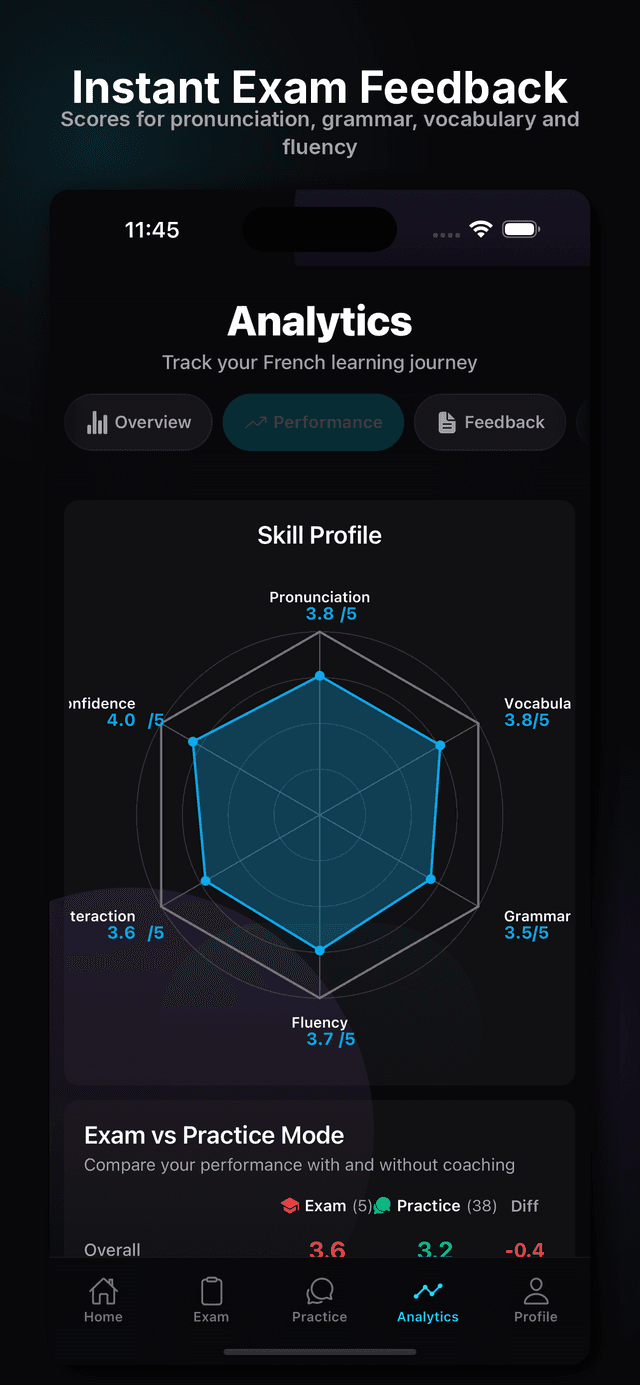
That is what this is for. You speak French out loud, the AI replies in French, and it scores you after every turn — pronunciation, grammar, vocabulary, fluency, interaction and confidence. Ten to fifteen minutes a day, four or five days a week, does more than an hour of silent revision the week before.
Seven sessions every 30 days are free, with no card. Paid plans start at £9.99 a month.
Most GCSE prep tools are text-based — you tap, you reply. Tête-à-Tête is different. You actually speak French, out loud, and the AI examiner listens, responds in French, and scores you in real time. Just like sitting your real speaking exam.
After every session, get scored on the six skills examiners care about: pronunciation, grammar, vocabulary, fluency, interaction, and confidence. Track improvement over time as you practise.
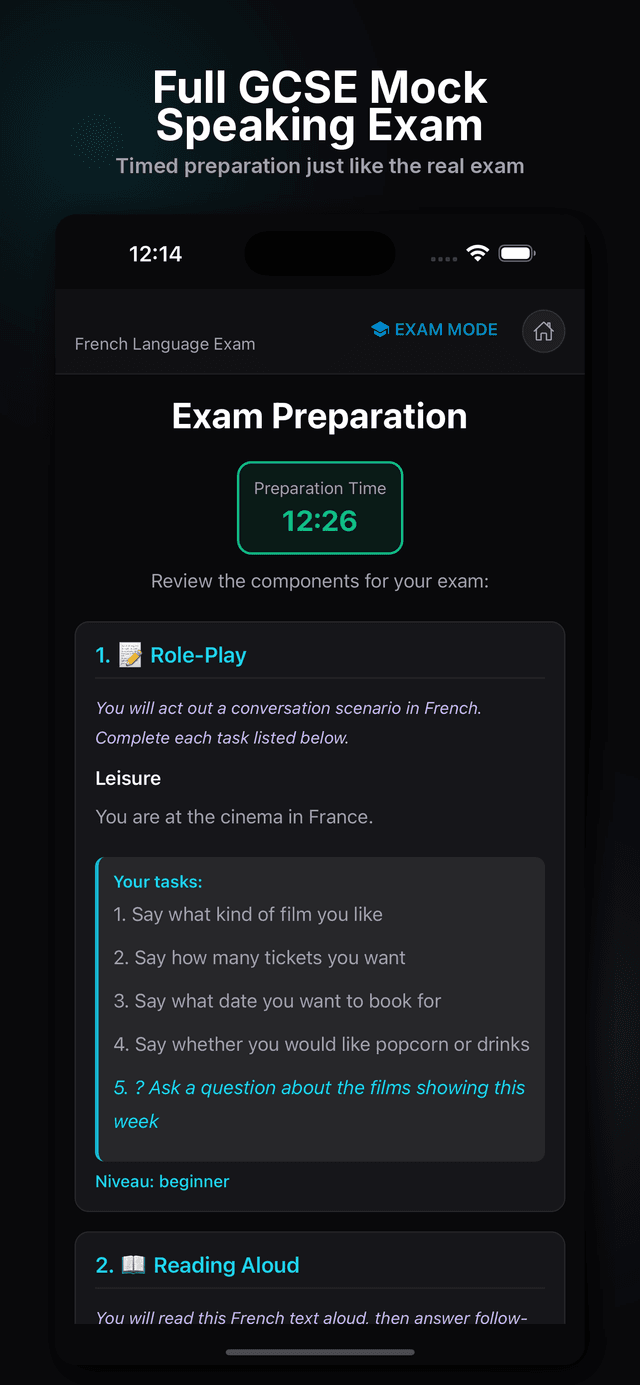
Sit a full timed mock French speaking exam — preparation phase, all components back-to-back, exam conditions. No coaching, no help. Finish with a complete report and predicted grade so you know exactly where you stand.
Use Tête-à-Tête in your browser at tete-a-tete.ai — no download needed — or grab the iOS app from the App Store, or the Android app from Google Play.
Quick answers about GCSE French speaking practice with Tête-à-Tête.
More GCSE speaking practice resources from Tête-à-Tête.
The same IGCSE format in Spanish — role play and two topic conversations.
Role play, reading aloud, photo card; Foundation and Higher.
Reading aloud, role play, picture-based discussion.
All boards — formats, timings and how practice works.
Every session builds confidence. Start free and hear how much you improve.